Story Of Walt Disneys Biggest Gamble Disneyland
ID:
TMS-5894
Source:
Newsweek
Author:
Lee Habeeb
Dateline:
Posted:
Status:
Current
When Walt Disney dreamed, he dreamed big. Bigger than most people dared. Some people, especially those closest to him, thought some of his dreams were delusions. Or reckless gambles. No bet Walt Disney ever made was bigger than the one he placed on Disneyland.
It started in 1923. The company Walt and older brother Roy started Disney Brothers Studio had become a world-famous brand thanks to characters and stories they’d hatched. The consequence was that thousands upon thousands of tourists descended on their studios hoping to see the Disney magic in person. Sadly, it was created behind the walls of ordinary offices and sound stages.
Walt saw an opportunity. “Whenever I run into a problem I can’t solve,” General Dwight D. Eisenhower said, “I always make it bigger.” Walt took the same approach to satisfying those disappointed tourists. Thus was born Disneyland.
Roy, chief operating officer of the company, was also chief skeptic. So too was Walt’s wife, Lillian. “Amusement parks are dirty and dangerous,” Walt’s bride told her husband, historian Alex Adler, host of YouTube’s Alex the Historian, told Our American Stories. “That’s just it,” Walt replied. “Mine wouldn’t be.”
Against his better judgment, Roy agreed to set aside money for research, while Walt tried several architects to draw the park’s plans, including famed architect Welton Becket. “No one can design Disneyland,” Becket told Walt. “You have to use your people to build this magic kingdom.”
While Roy was able to find early backers, he struggled to find more. “[Walt] took out $50,000 from his life insurance and sold his Palm Springs vacation home,” Adler said. “When Lillian found out he’d spent over $100,000 of their money, she was livid.”
A turning point for Walt’s dream came in the form of rejection: The Burbank City Council said no to his park. Walt didn’t shrink his vision. He instead hired a land man to find the perfect spot. “It was a 200 acres of orange and walnut groves in the sleepy rural town of Anaheim, California,” Adler said. The land was cheap and close to the I-5 Freeway (then under construction), affording proximity to Los Angeles and San Diego.
Funding problems persisted. “ABC Television Network needed a big name like Disney to boost their popularity,” Adler explained. “ABC agreed to fund a large portion of the construction in exchange for Walt starring in a weekly Disneyland TV show and giving them 35 percent ownership of the park.”
With deal in hand, Roy reapproached Bank of America which had staked the loan for the land and secured additional credit. Still, few involved with the project believed it would succeed.
Construction began in July 1954, with Walt insistent the park open in July the next year. “All the while, Roy was worried about how the park was going to turn a profit,” Adler noted. “Until Swift Meatpacking Company agreed to operate the Market House on Main Street, which opened the floodgates to other corporate sponsorships.”
Months later, Walt invited his pal and popular TV host Art Linkletter to show off the park’s progress. “We were driving through orange groves and dirt roads,” Linkletter recalled. “I didn’t tell him what I really thought—that he was out of his mind.”
Walt made brilliant choices in the park’s design. “He didn’t want the public to see inside the park from the outside, and didn’t want the landscapes within to be shattered by views of the surrounding city,” Adler explained. “When earthmovers dug out lakes, canals and streams, the massive amounts of excavated dirt were used to create a system of berms around the park, some towering 30 feet high. There was even enough dirt to create rolling hills and islands.”
Forced perspective was also a design feature. “Walt wanted guests entering the park to marvel at its size, so the building facades on the north end of Main Street were designed slightly shorter than facades at the south end, giving the illusion of distance,” Adler explained. “This worked well in reverse, because at the end of a tiring day, the guests would head back to Main Street, and the larger buildings at the south end made the exit of the park look closer than it really was.”
All the while, funds for Disneyland were in short supply. “The studio itself wasn’t producing any live-action movies as various sound stages were used as fabrication sites for ride systems and special effects,” Adler explained. “Everything they’d built over the last 27 years was sunk into Disneyland.”
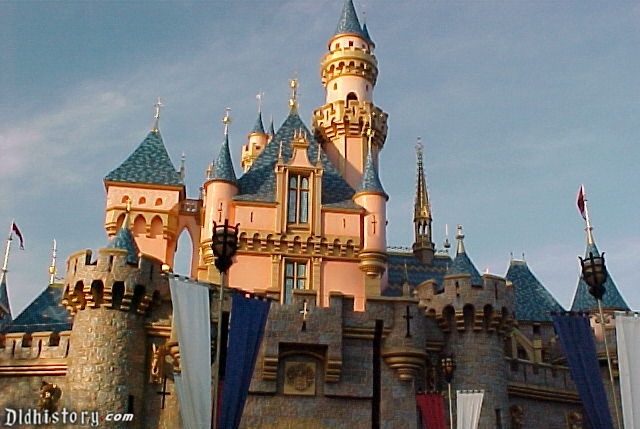
None of which deterred Walt. “He insisted the finial caps on the rooftops of the castle’s turrets be made of gold to impress guests,” Adler explained. “Roy insisted it was too costly, but Walt ordered gold finials anyway. Roy later admited the gold finials was a good decision.”
Then came opening day, and ABC’s live broadcast done on a scale never seen in TV history. “ABC borrowed and rented 29 cameras, used 80,000 feet of cable and 14 forklift camera platforms to deliver the festivities to a record-breaking viewership of 90 million across the country,” Adler exclaimed.
That morning, Roy headed from L.A. to Anaheim down the brand-new I-5 Freeway. Mere minutes from the park, he hit traffic. “His heart skipped as he wondered if construction was preventing people from getting to Disneyland,” Adler explained. “As Roy exited onto Harbor Boulevard, he realized the 7 miles of traffic was people waiting to park their cars at Disneyland.”
Opening day was fraught with problems including record summer heat. The park was packed with 28,000 fans, which exceeded the park’s capacity by 10,000. Opening-day hiccups notwithstanding, Disneyland’s millionth customer passed through its turnstile just 90 days later. In February 2025, the billionth customer did the same a number not even Walt could have dreamed up.
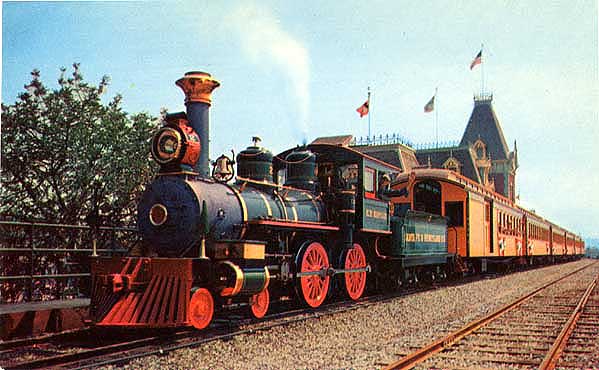
Why was Disneyland such a success? “Average working-class people were able to experience a cruise through exotic jungles, take a romantic journey aboard an authentic stern-wheeled steam riverboat, fly over London as Peter Pan, and hear the cry of a steam whistle as an 1800s locomotive hauled happy visitors around the Magic Kingdom,” Adler explained. “It was truly a park like no other in the world.”
No entertainer in American history was better than Walt Disney at connecting with his audience. “He knew how to deliver an experience that could take you to the corners of the Earth and your imagination,” Adler noted. “And all of it in one Magic Kingdom built by a man who made us believe that when you wish upon a star, your dreams can come true. Because they did for him.”
Walt Disney enjoyed the park for only 11 years, dying from lung cancer in December 1966. He was 65 years old.
Attractions Referenced In This Article:
Restaurants Referenced In This Article:
Lands Referenced In This Article:

 Access To Over 3240 Construction Photos